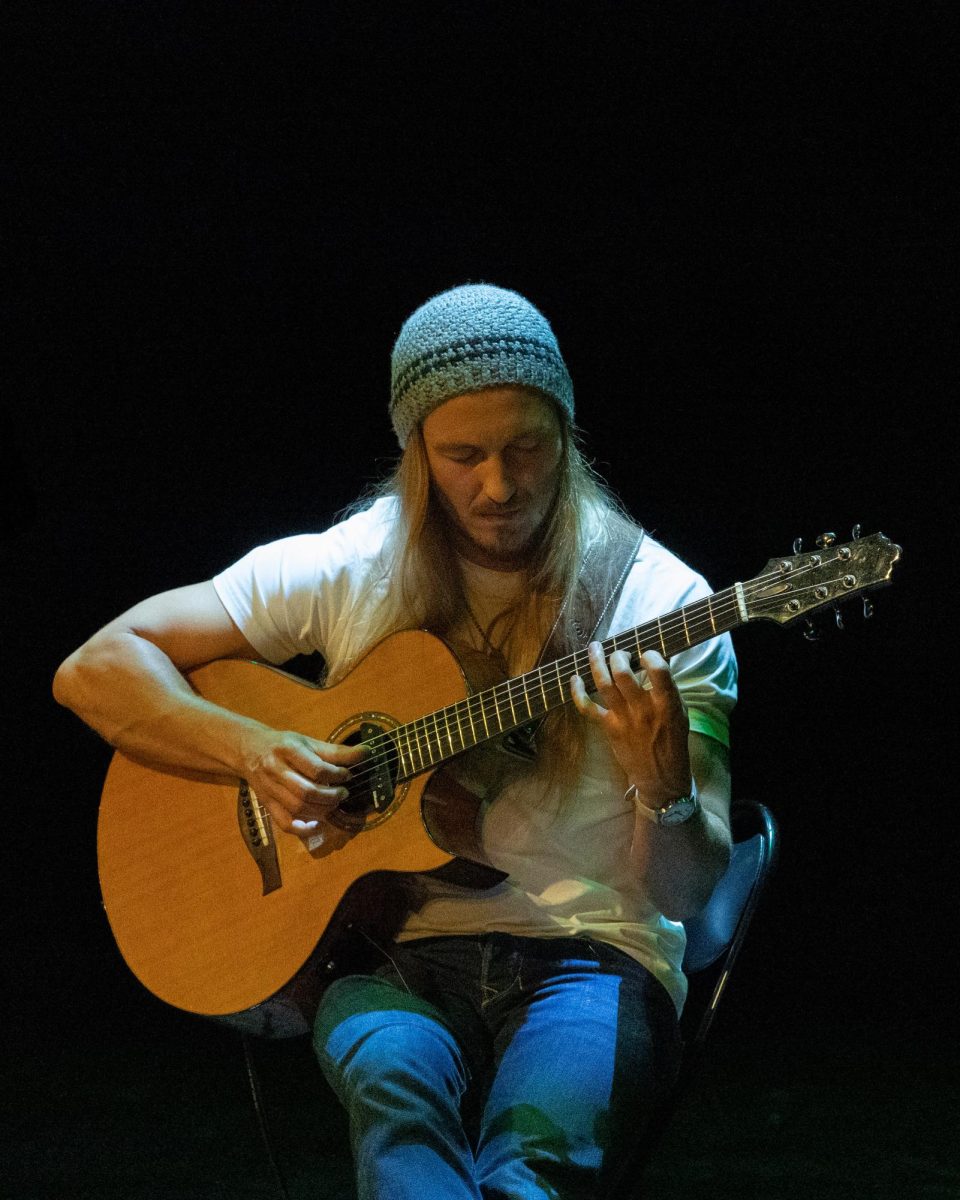
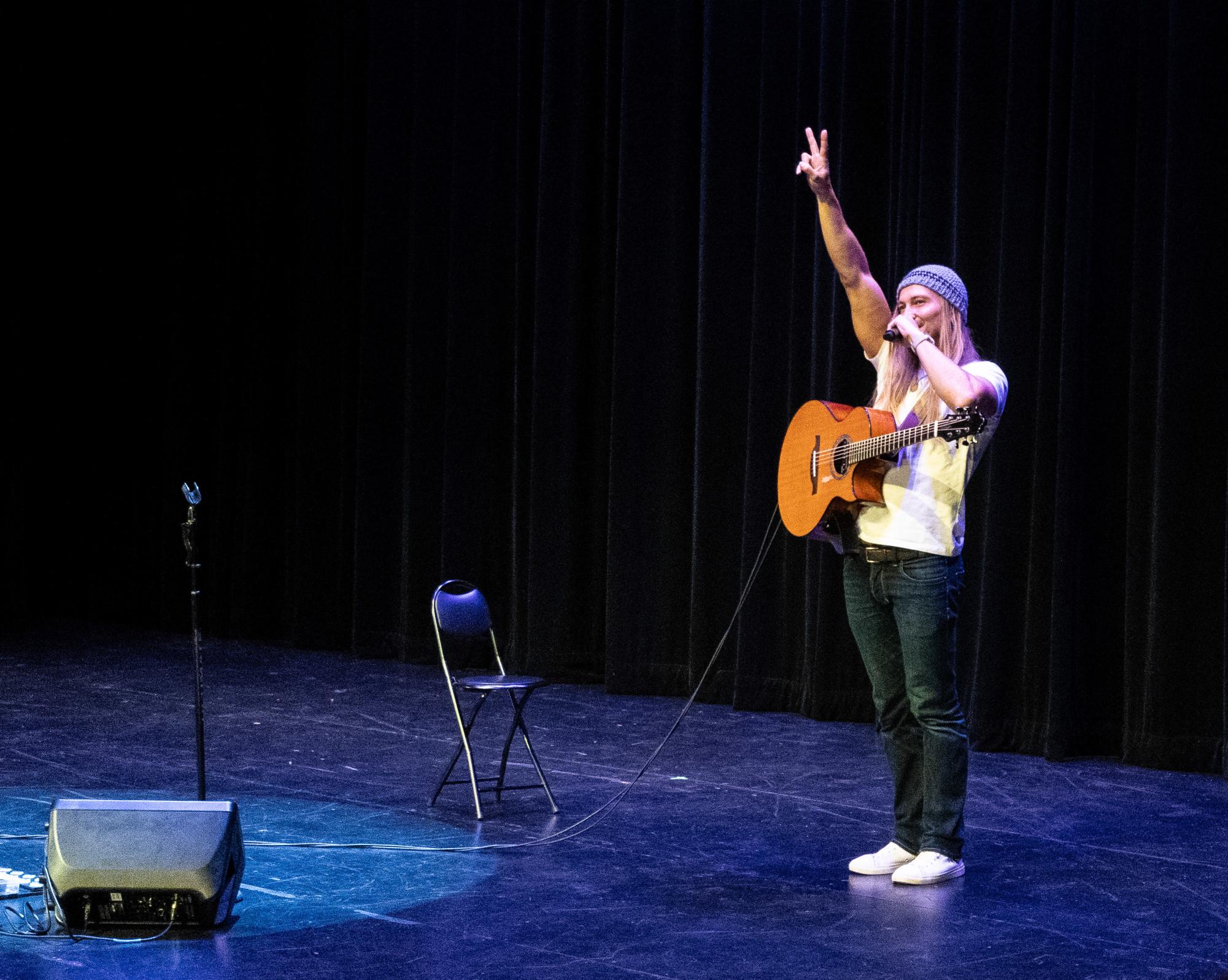
De Anza College’s Visual and Performing Arts Center came alive as Canadian fingerstyle guitarist Calum Graham took the stage for a 75-minute concert that captivated listeners across the San Francisco Bay Area on the evening of April 24.
Long before the concert started, the lobby was already bustling with fans, snapping up Graham’s latest album displayed on a long table at the entrance. The whole space was inundated with energy and excitement.
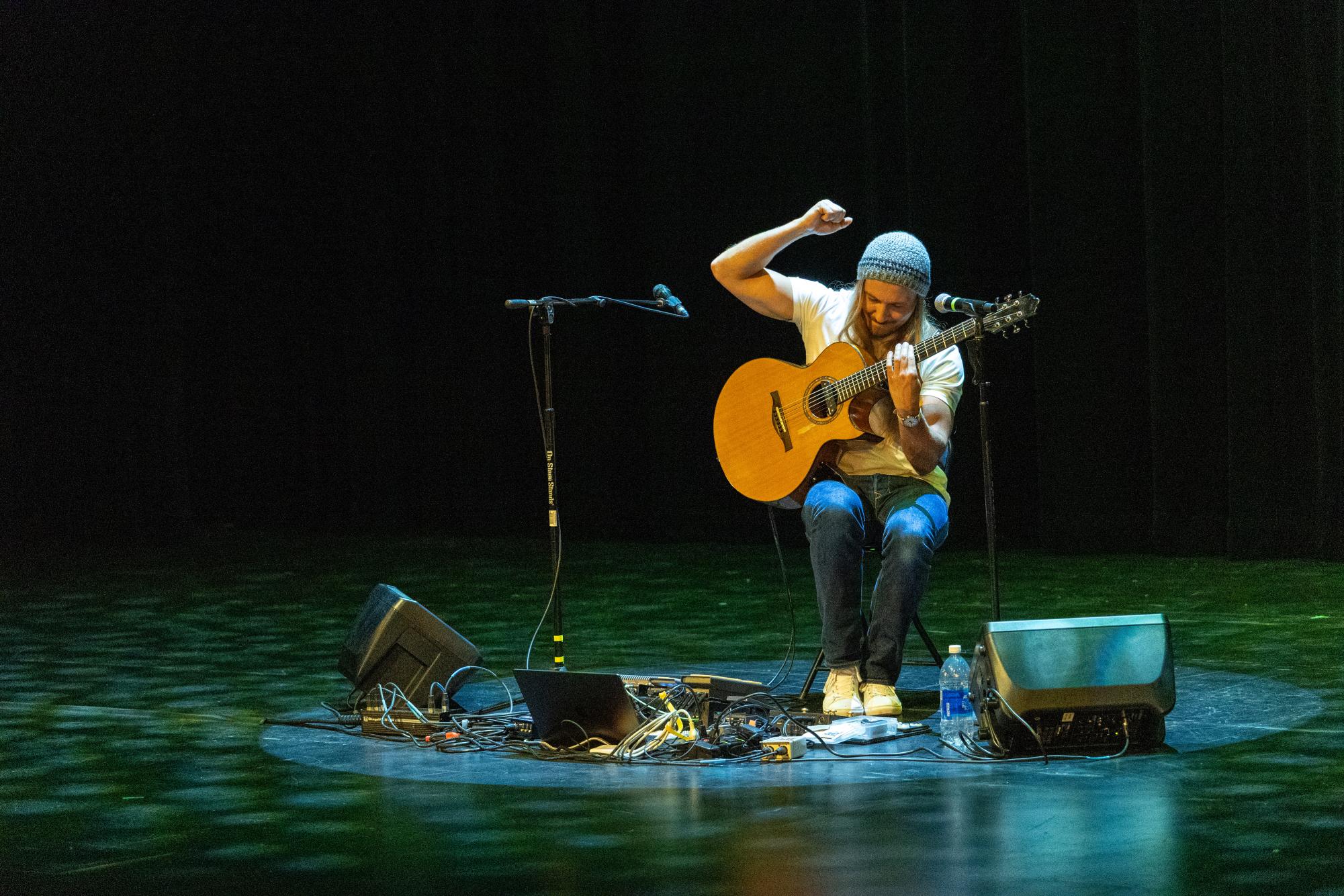
As the hall lights dimmed and a soft blue glow emerged onstage, Graham opened with a piece that sounded clear and gentle like water drops. His fingers danced across the strings in a flurry of motion.
After a thunderous round of applause, Graham broke the silence with a dose of humor.
“I was a chicken dad. I used to have four chickens,” Graham said. “But now I only have three … I got hungry once.”
The whole room burst into laughter.
Between each instrumental song, Graham charmed the audience with his easygoing humor and stories behind the music.
“I started playing classical music in the baroque period, but this piece wasn’t necessarily inspired by the baroque era,” Graham said as he introduced “12:34,” his duet album with fellow Canadian guitarist Don Ross. “It was written at a time when I was broke.”
The audience burst into another wave of laughter.
Throughout the evening, one standout piece was “Maelstrom.” Graham introduced the song with its music video.
Graham and his team filmed it at Glacier Point in Yosemite. Its rhythmic structure felt like standing on the vast expanse of rolling hills.
One touching moment came when he introduced “Waiting,” a song he wrote for a friend who had a stroke.
“I wrote this next song for a friend who is learning life all over again at 65 years old,” Graham said. The guitar strings vibrated in the warm yellow light, evoking memories of life’s fragility.
Later, Graham introduced “Tasakaal,” an album he co-created with a neuroscientist in Idaho, designed to stimulate different brain frequencies for relaxation, meditation and concentration.
“Music has always been something that’s brought a lot of peace in my life,” Graham said. “And my hope is that this album brings a little peace to your life as well.”
When the microphone momentarily cut out, Graham didn’t miss a beat. He continued with “Farewell,” a piece to a late friend, followed by “The Nomad,” a dynamic song inspired by his musical idol Michael Hedges.
Even without the assistance of the microphone, the rhythm was so exhilarating that it evoked a horse galloping across a grassland.
The energy surged when “Lighthouse,” a song for his sister and Graham’s first vocal performance of the night, was unveiled. His sonorous voice, along with the guitar, reflected his strong support for his sister.
“She had a very difficult life growing up,” Graham said before his performance. “I hope she hears it one day.”
Though the concert had come to its ending time, Graham rewarded the crowd with additional songs: “Tabula Rasa,” co-created with Andy McKee and Trevor Gordon Hall and “Phoenix Rising,” a fan favorite with over five million YouTube views.
The final number featured a drum-like, high-energy piece, and as Graham clapped in rhythm, the entire hall joined in, ending the night on a high note.
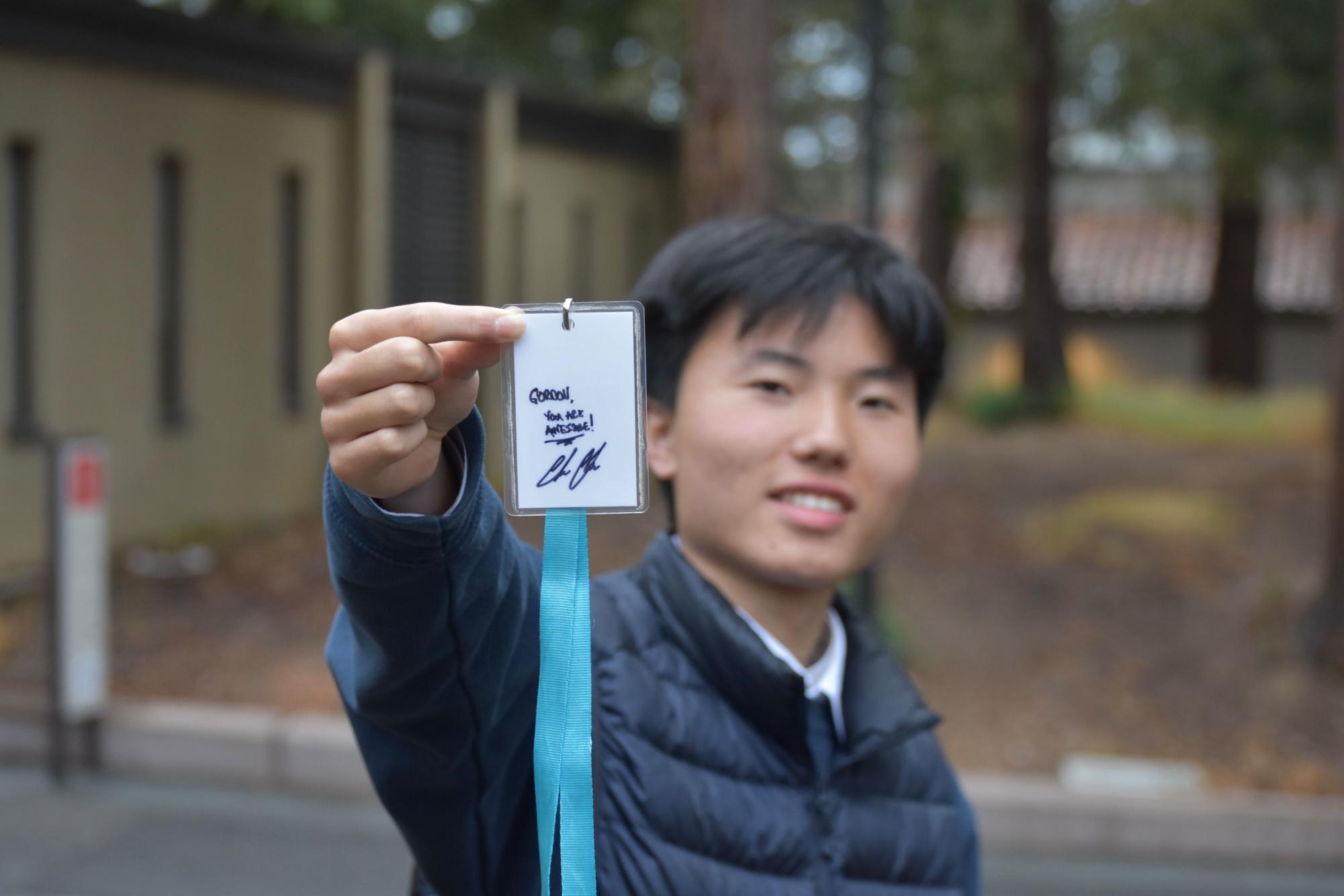
After the show, fans lined up in the lobby to meet Graham one by one. Nestor Gutierrez, a longtime fan from Cupertino, said, “I’ve been listening to him for 10 years. His style is unique. I do like the way that he’s joking around. I wish this concert would be longer.”
“It is a really good experience as an audience to have an artist that is talking to you,” Sarah Gutierrez, Nestor’s wife, said.
Graham said the show was amazing, despite the technical issues.
“Playing live is like life — things happen, and you can’t let it get you down,” Graham said.
He spoke of picking up the guitar at 13, inspired by his father and other famous players, such as Michael Hedges and Antoine Dufour.
“With six strings and 12 notes, you can create another world to get lost and take people away for a little bit,” Graham said.