On the evening of June 5, De Anza came alive with stargazers, telescopes and wonder as students, faculty and community members gathered for a planetarium show and Star Party. Hosted by the Astronomy Department, the Fujitsu Planetarium and the Physics Village, the event highlighted a rare and exciting collaboration between some of De Anza’s most vibrant science spaces.
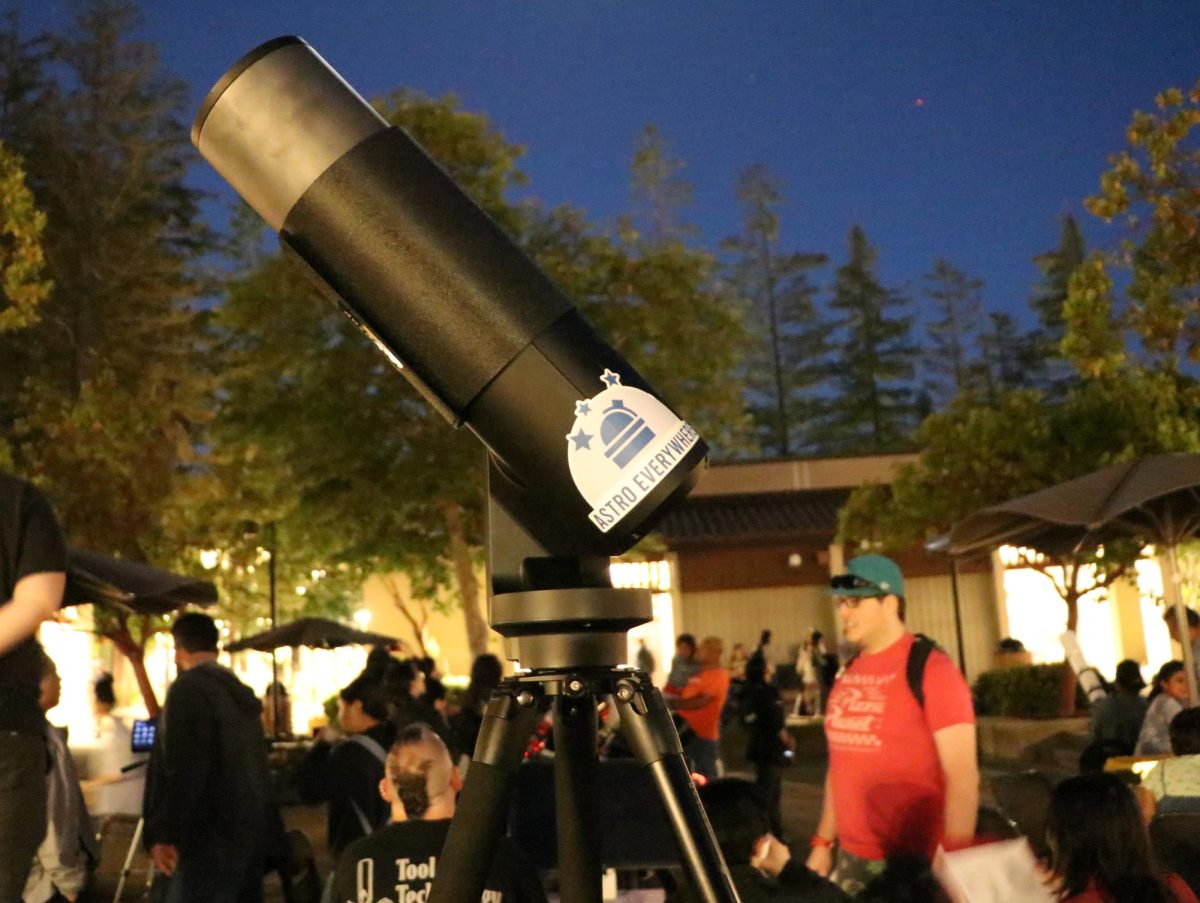
The event consisted of two parts: an engaging show inside the Fujitsu Planetarium and the outdoor Star Party in the sunken quad outside the Planetarium, allowing participants to dive deep into observation of celestial objects through telescopes.
“We don’t normally do things together,” said Mariah Panely, De Anza’s planetarium specialist.
Panely said that the Astronomy Department and planetarium staff usually work on different schedules.
“Usually, they’re using the planetarium when I’m not,” Panely said, “so it’s fun to collaborate.”
Outside, in the planetarium quad, astronomy instructor Marek Cichanski operated a high-powered, electronically assisted telescope system. His live imaging setup allowed attendees to view distant objects, such as the Virgo galaxy cluster and Messier 3, a densely packed globular star cluster.
“We’re using a method called Electronically Assisted Astronomy, or EAA,” Cichanski explained. “It uses a camera system much more sensitive than the human eye. That’s how we can see objects millions of light-years away in real time.”
Caitlin Kepple, the astronomy instructor and lead organizer, began planning the event early in the spring quarter, emailing colleagues to coordinate scheduling.
“We usually hold it around Week 9, and Thursday nights work best,” Kepple said. “This is the first time we’ve done it two quarters in a row and definitely the biggest one so far.”
The event was organized to give students direct experience.
“I really just want students to be able to look through telescopes and see some real objects,” Kepple said. “I think one of the big things is that, especially in my classes or other instructors’, you’re showing students NASA images. This is giving students real hands-on experience with looking through a real telescope themselves and seeing the reality of it.”
Three telescopes were set up: one focused on the moon, others on deep sky objects and Kepple’s own manual telescope.
Despite the late summer sunset delaying full darkness, dozens of students gathered around monitors, telescopes and projection screens, catching views of the moon, faraway galaxies and star clusters deep into the night.