Ukrainian students at De Anza said they remain deeply affected by war in Ukraine as Feb. 24 marks three years since Russia’s full-scale invasion of their homeland.
After eight years of regional conflict in the Donbas region of Ukraine between pro-Russian separatists and the Ukrainian government, Russia escalated the war by launching an invasion on Feb. 24, 2022.
This sparked the largest war and refugee crisis on European soil since World War II, with over 12,000 civilians and approximately 46,000 Ukrainian soldiers killed. Russian casualties aren’t fully known, but some estimates have them at around 434,000, according to the Institute for the Study of War. Over six million Ukrainian refugees have also fled the country.
In 2025, Human Rights Watch accused Russian forces of committing war crimes against both Ukrainian soldiers and civilians, with indiscriminate bombings, executions, torture, rape and around tens of thousands of Ukrainian children being abducted and deported to Russia.
Yuliya Palamarchuk, 30, project management major, said she was among the millions of Ukrainians in the country at its start who later became refugees, and that the war drastically changed her life. Palamarchuk said she lost family members to the invasion and her stepbrother enlisted for the Ukrainian military.
“It made me move to a different country. It made me leave the place where I lived. I had to switch jobs and leave my family,” Palamarchuk said. “I haven’t seen them for a while now and my father died because of the war.”
Anastasiia Holovchenko, 19, psychology and data science major, was also in Ukraine when the war started and currently serves as the vice president of the Ukrainian Student Association on campus.
“(I was) in it and experiencing the war myself, and seeing how my family, my friends and people around the block have been affected, seeing people gathered in such fear,” Holovchenko said. “I saw civilians fleeing with just their children, pets and a few precious possessions.”
Holovchenko said she has not been back to Ukraine since the war started, but that she does what she can to raise awareness of the war with her involvement in the Ukrainian Students Association.
Yaroslava Klymenko, 18, political science major, serves as Inter-Club Council representative for the club.
Klymenko said she and other Ukrainians found it challenging to go on with a normal education.
“It’s difficult because I can’t talk to anyone. I don’t think anyone else can relate (to the Ukrainian experience) besides the Ukrainian community,” Klymenko said. “I came back … from Ukraine, and I noticed that I started to become very aware of the sound of an airplane. It made me scared because in Ukraine, if you hear an airplane then you know it’s probably (a military plane).”
Palamarchuk said many Ukrainians worldwide feel similarly.
“I’d say that Ukrainians are generally more stressed, more anxious. Most people I know don’t sleep well,” Palamarchuk said. “Just because I’m here, there is still war going on in my country, so I’m still living in wartime while trying to conduct normal life here in the U.S.”
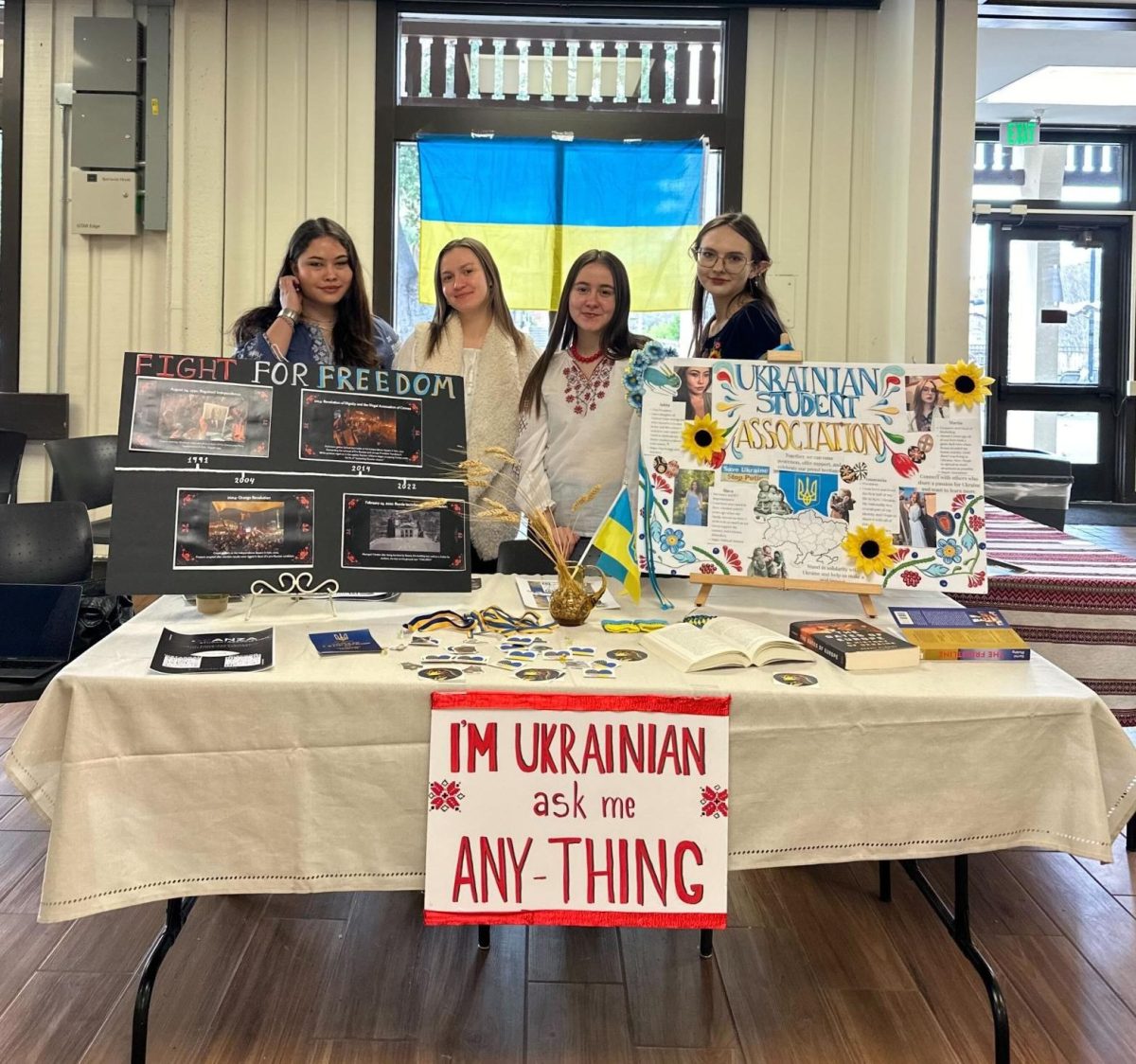
On Feb. 24, the Ukrainian Students Association set up a table in the campus cafeteria to mark the third anniversary of the war.
“They care and they see that it is a terrible thing that’s happening, but they just don’t have that personal connection,” Klymenko said. “I was hoping that we could be that personal connection for the students here, so that … you could put a face to it.”
The Ukrainian Students Association continues to provide information and resources to support the defense of Ukraine and help refugees and victims of the war for those looking to learn and help however they can.
“Not everyone might have the funds to give directly to Ukraine, and not everyone feels comfortable doing that, but there’s always something you can do to help,” Holovchenko said.
The Trump administration, pushing for a resolution, clashed with Ukrainian President Volodymyr Zelenskyy during an Oval Office meeting on Feb. 28 which led to a pause in U.S. military aid. As of March 11, Ukraine’s war with Russia has slowed to a war of attrition, with Russia making slow, but costly gains, according to the Institute for the Study of War. President Zelenskyy has agreed to a 30-day ceasefire plan, prompting the U.S to restore aid to Ukraine. Russia has yet to agree to the deal.
Klymenko said she still holds onto hope, seeing victory as achievable. Klymenko said she believes the best way towards peace is for all the Russian-occupied territory to go back to Ukraine and for her home country to join NATO and the EU.
“Europe, America and Ukraine’s allies have to put up a strong, united front. So I think it is 100% achievable,” Klymenko said. Klymenko also said Ukraine needs security guarantees from Russia and NATO for the country to move forward instead of having to keep watching its back.
Daniel Ramirez, 23, history major, is a guest contributor for La Voz.