
Located on the far edge of De Anza’s campus, behind the empty stretches of parking lot D and construction fencing, is a hub of some of the most cutting-edge environmental science work done on campus. Born directly from a multi-year student organizing campaign, the Kirsch Center for Environmental Studies’ sand-colored walls house the Environmental Studies department.
The center is the first community college building awarded the LEED Platinum certification, the highest level of green building achievement. In the spring quarter of 2024, a group of De Anza students set out to investigate just how sustainable its design really was.
Students in professor Gayatri Pal’s environmental biology class, Yuanbo (Aaron) Pang, 19, computer science major, Taohao Le and Kartik Kumar Singh combined forces with Hongming (Arvin) Liu, 22, math major, and Cecilia Ji, 19, economics major, co-founders of the Environmental Economics Club, to evaluate this very question. Bringing backgrounds and interests ranging from computer science, environmental science and economics, the group completed an interdisciplinary project over the course of roughly four weeks.
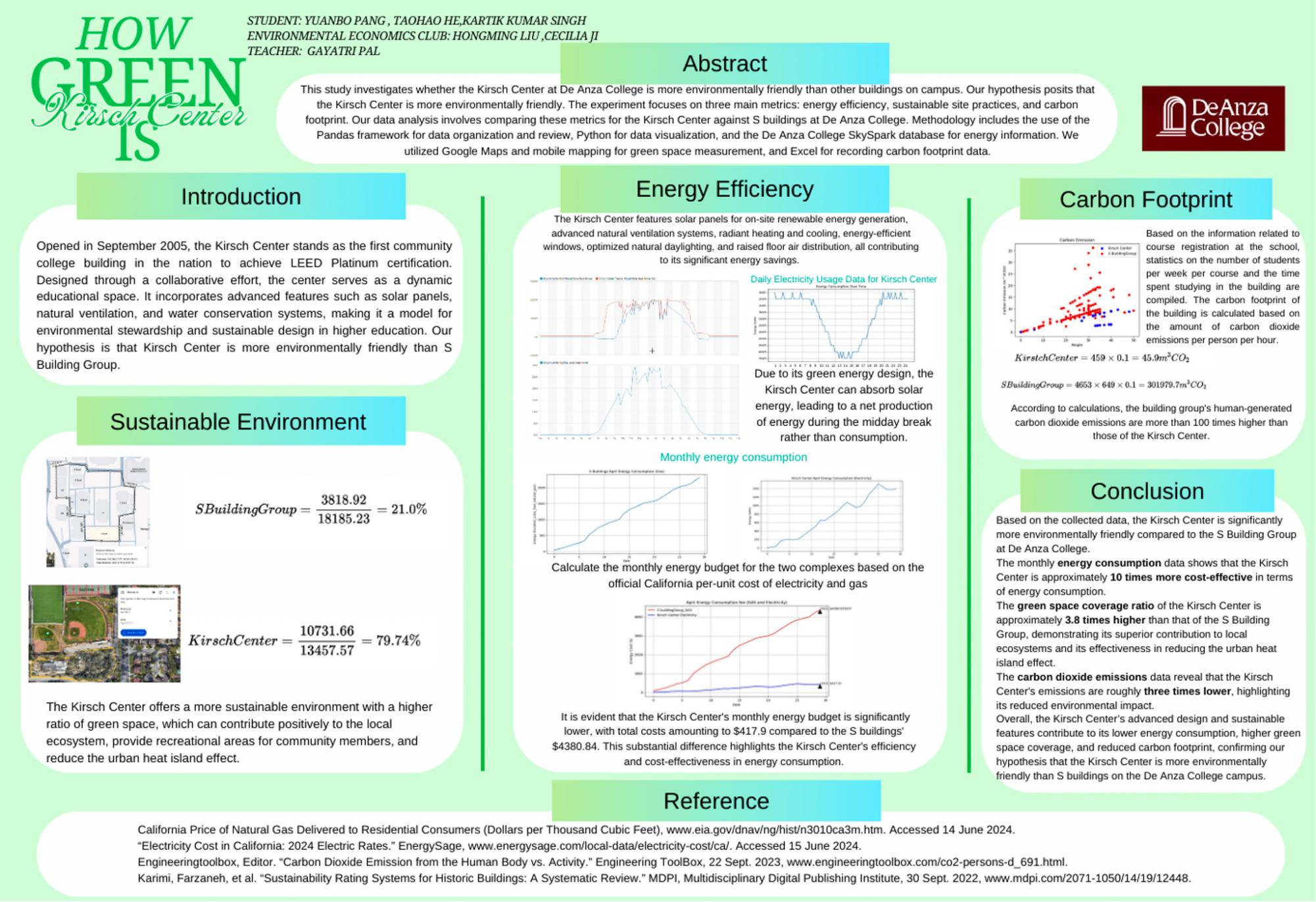
Ultimately, the students found that the Kirsch Center was approximately 10 times more cost-effective in its energy consumption compared to the S-building group, one of the oldest on campus. It also had 3.8 times the foliage coverage ratio in its overall land area and emitted roughly three times less carbon dioxide, implying it is significantly more economically and environmentally sustainable.
“It really calls for major (change) so that you can tear down, or (make) some improvements,” Pal said.
How did they do it?
The group chose the S-building as the basis for comparison because it is one of the oldest buildings on campus and keeps energy-use data, which a lot of other buildings do not have. It is also gas-powered, which is the biggest difference between it and the Kirsch Center, which relies solely on electricity.
“For the Kirsch Center, it has its own solar (panel) system, so when the students (are) not here, it can also generate energy,” said Pang.
The energy data was gathered by consulting the SkySpark energy usage database maintained by professors Richard Holman from De Anza and Robert Cormia from Foothill College.
Liu calculated the ratio of green space to plot area of both buildings by painstakingly using the “Measure” app on his iPhone and using the satellite setting in Google Maps to double check which areas were considered “green.”
“I (spent) a whole day to calculate how much the area is green plants, and how much area is just the building to calculate the (total ratios),” Liu said.
The project timeline
Pal, a part-time professor of environmental biology, has been teaching at De Anza for more than 10 years. Though she is a molecular biologist by training and started off as biology faculty, her interests gradually shifted towards nature and switched to teaching exclusively environmental science for the past three years.
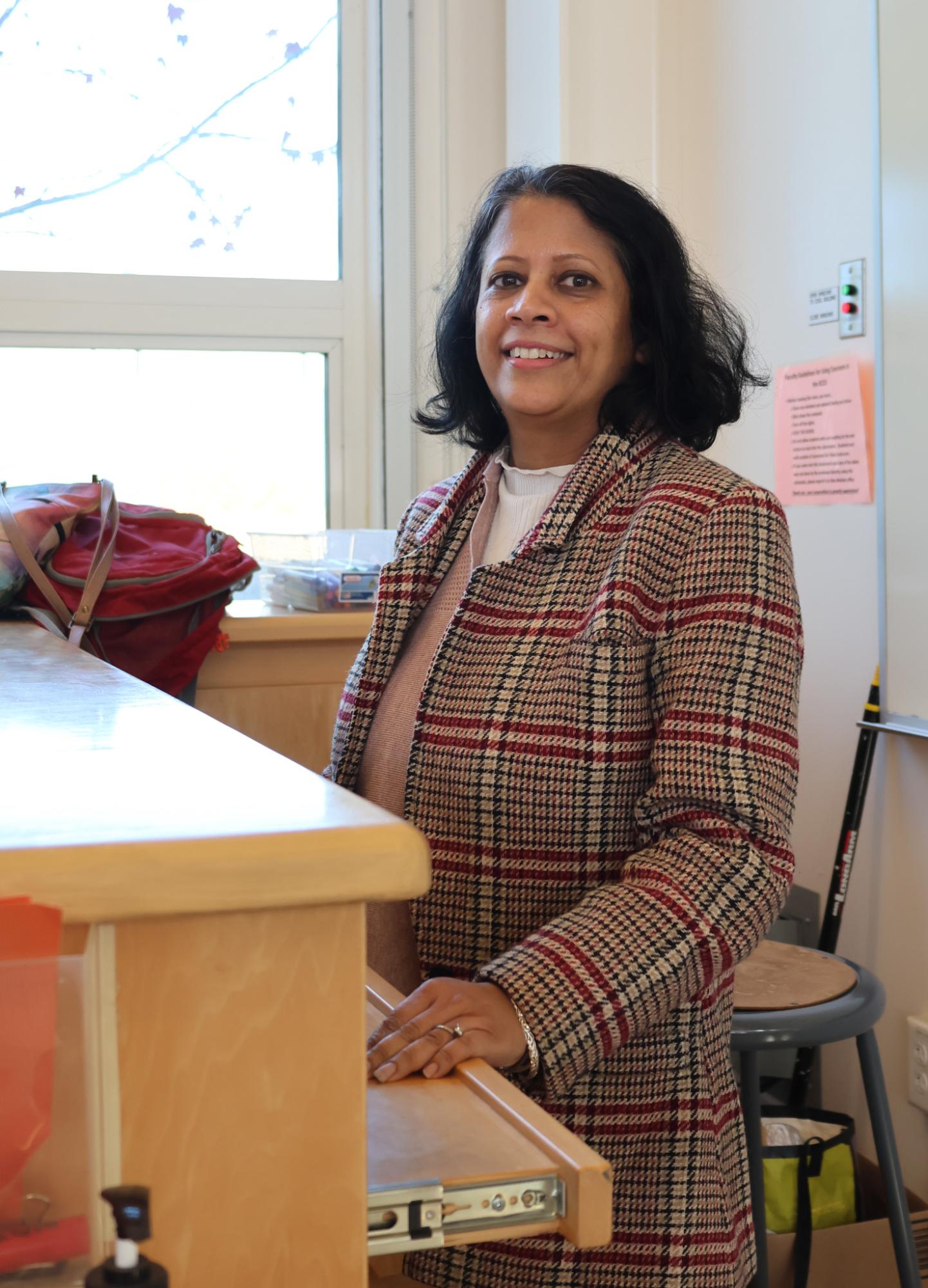
Ever since making the switch, Pal said, “I can connect so much more with my students, because they understand they are being impacted. It is a direct impact, and they want to learn more. So this is why I get talented students like Aaron, Cecilia, and Hongming who want to push the boundaries, who want to do more.”
Though the project was completed as part of Pang’s environmental biology class in the spring quarter of 2024, the idea took root earlier in the winter 2024 quarter. Pang was thinking about how to apply his background to environmental science and reached out to Pal for guidance before even registering for her class.
Meanwhile, Liu said, “Before this project, I (had) the idea to do something about the protection of the environment and to do something to (bring) awareness (to) the peoples’ thinking, to know the different energy, like the older energy and the new energy — it has a very different cost, but I didn’t have a very good idea how to do it. So I created this Environmental Economic Club (along with Cecilia).”
Ji is a former student of Pal, and encouraged him to reach out to her.
“I think she’s really enthusiastic because when I took her environmental science class, she helped me a lot, and also on the later personal project, she’s a really enthusiastic and helpful professor,” Ji said. “So I said, ‘Okay, maybe you can try to reach out to her.’”
Coincidentally, Pang, Liu and Ji were all already friends as well as either current or former students of Pal. It all came together when the professor connected the dots, and suggested they combine their ideas together on a project idea she had been nurturing herself.
“I wanted to start this series where students are going to do hands-on experiments, (and) I wanted to add this topic, ‘How green is the Kirsch Center?’ And then it just happened, it all (fit into the) right places,” Pal said.
What did they learn from this project?
Prior to the project, Ji felt lost on how to apply environmental economics in practice.
“I think (environmental, social and governance) is a concept that has been raised in a lot of business competitions for a couple of years already, but I really (didn’t) understand how it worked,” Ji said. “Because there are large companies (that follow the) ESG handbook, but I feel like they are just doing some really surface-level things … not really helpful to a business.”
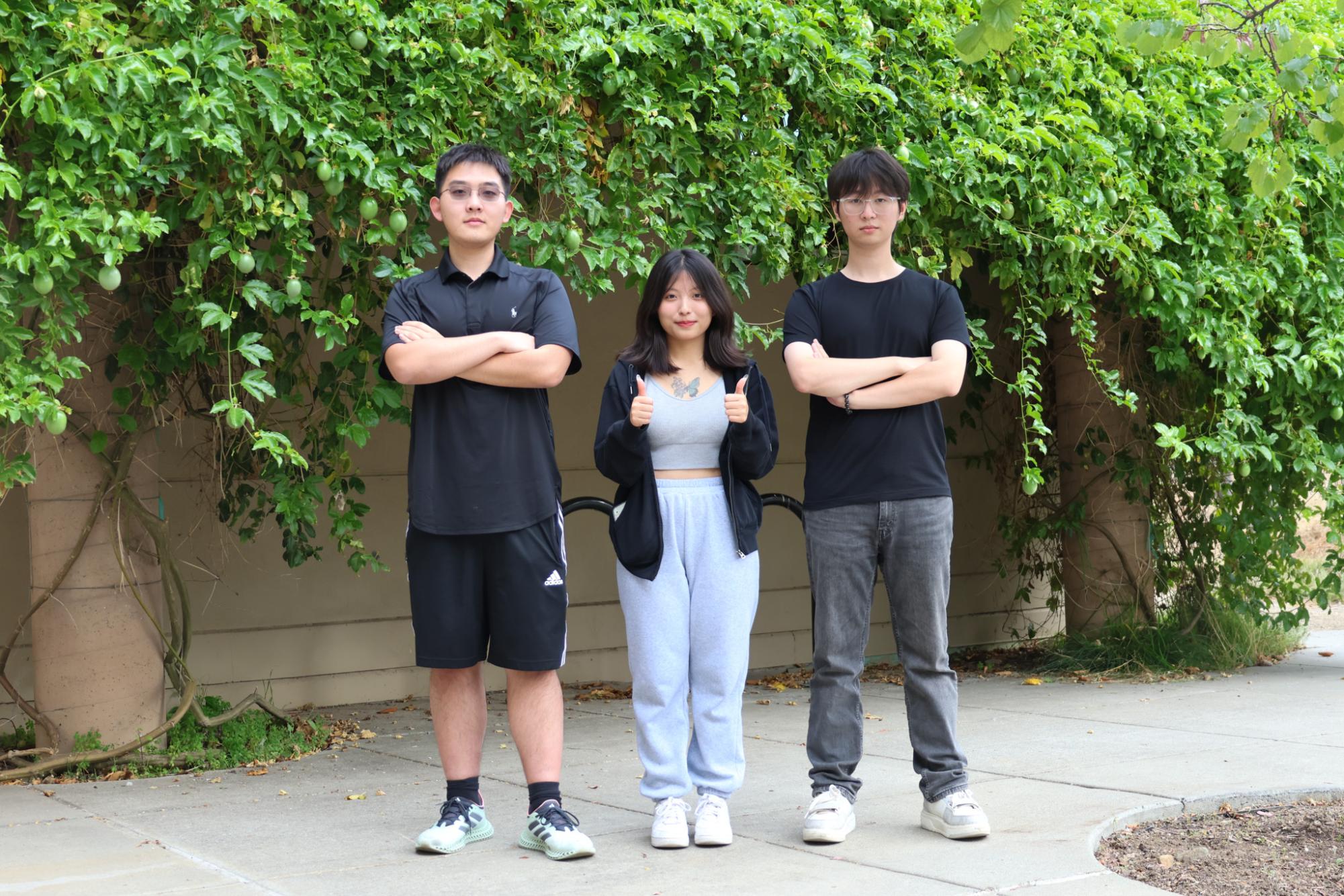
Doing this project opened her eyes to the key questions of environmental economics, and helped her to gain a deeper understanding of the field.
“After I (finished) the project with the club and also Pal, I started focusing more on the environmental aspect related to economics and did a lot of research as well,” Ji said. “And then I started to … really think about how environmental design could bring in a better economic profit, no matter (if it’s) to a business or … to our society or our community.”
It also helped her to see a wider future beyond her major coursework, toward the broader applications of economics.
“At least for me, when I just entered community college, I had a feeling that I’m not smart enough, I’m not competitive enough. I feel like my life is just done, and maybe my future career will have to relate to my major,” Ji said. “But right now, I see more potential on how different majors can intersect with each other, and also how they can make a bigger impact by solely doing one specific major.”
As a first research experience, this project helped to open new doors for Pang.
“I got another research internship at Stevens Institute of Technology researching something in deep learning,” Pang said. “Not just because of this, I also have some background (in) AI. But this project is my first. (It) gave me a lot of experience and (taught) me how to do the research.”
Not only did it prove to be an important learning experience for the students, it also served as a wakeup call for Pal on the inevitability of integrating computer science into the field.
“At first I was like, what, Python? Sorry, I know that it’s in dire need, I need some integration, but I have no expertise,” Pal said. “So it’s going to be a traditional environmental science class where we do these hands-on types of experiments.”
Now, she tentatively plans to take computer science classes, and has ideas for creating new interdisciplinary classes at De Anza, such as programming for scientists.
Where do they see themselves going in the future?
Taking from his portion of the project, Pang sees how energy use and cost efficiency can apply to the increasingly important field of energy management as a whole.
“Nowadays, like Nvidia, there’s a lot of GPU(s) and the data center(s) need a lot of (power). And also … Microsoft, they want to pay for a new clean energy,” Pang said. “So it’s like, the next level … (is) the energy generation and the energy management.”
Nurturing an interest in environmental economics, Liu has been independently following the research of Cornell University professors to learn more about the field, and in the past, ended up writing an essay on the changing weather impact on future markets.
“I focus on this subject because I think in the past 10 and 20 years, especially in developing countries, we just (focus) on how to quickly (build) the new house, new buildings, how to quickly make money and to build the bigger market,” Liu said. “But we didn’t see (that) the environment (will) be broken by human action, or business action, and this part will impact (the) future.”
Summarizing his thoughts on the project, Liu gave a call to action on the importance of this field.
“And now I think we need to get more (attention) on it. We need to (raise) awareness, (for) more people to see it, not only to put protection(s) on the environment (or) ban economic development,” Liu said. “It’s to focus on how to use clean energy, more (green) actions to develop our economics and at the same time to protect environmental health.”
Other articles about the Kirsch Center:
- “Kirsch Center chosen out of 10 schools for award”
- “From Kirsch Center to kitchen, students sow sustainable crops”