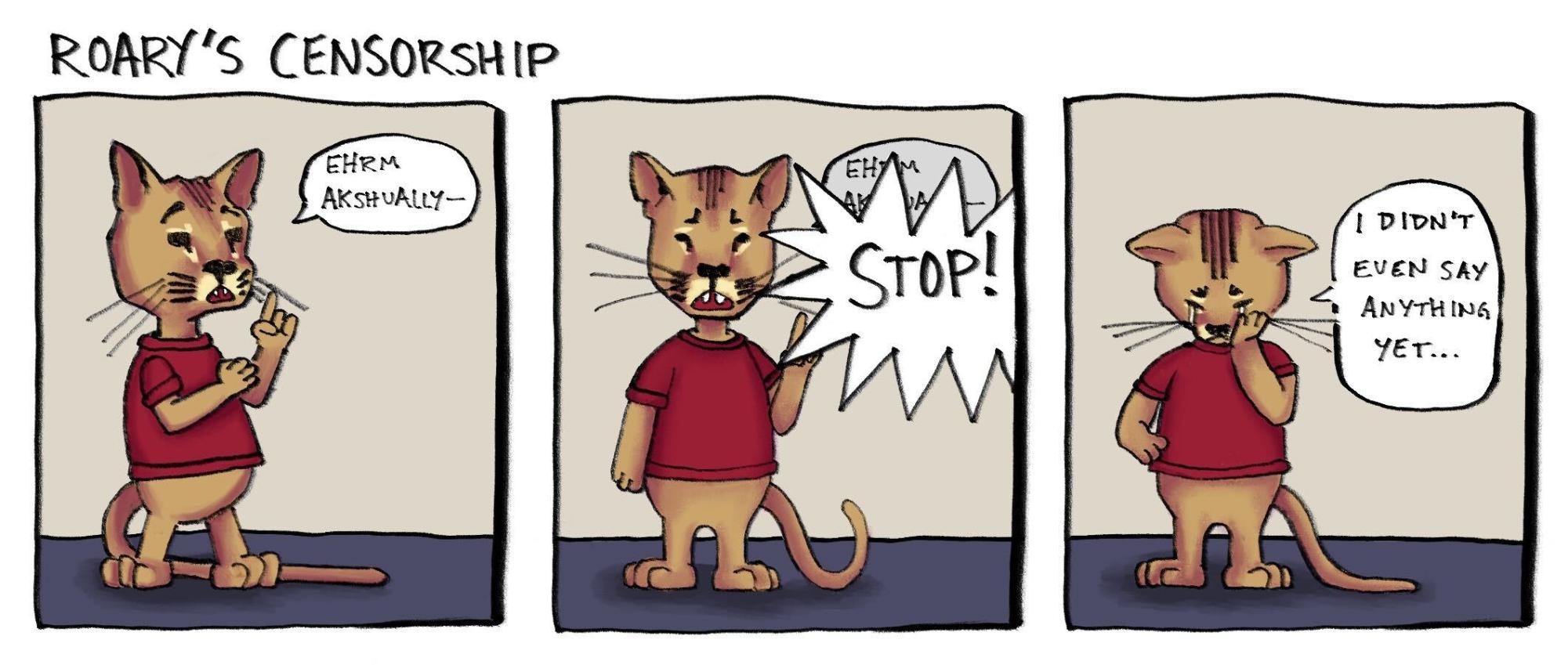

Free speech in the Foothill-De Anza community college district is under attack. De Anza College students have an obligation to use the free speech they are still afforded to protect it across the district, before the restrictions imposed on students on Foothill College campus slowly normalize and make their way to this campus.
While Foothill’s administration recently repealed parts of its time, place and manner policy — in particular, its students are no longer subject to punishment for holding “expressive activities” on “grassy areas, walkways and other open spaces that are visible and accessible to the college community” — it is unacceptable that it was the case in the first place, that most of the policy remains (including the time constraints) and that the college is able to reinstate those policies at a moment’s notice, per its president’s discretion.
After months of chalk art in the wake of Israel’s siege on Gaza, as well as a walkout for Palestine on May 1 and an art installation recognizing the children of Palestine in the library quad prior to that, Foothill’s administration chose to restrict all “expressive activities” to Cesar Chavez Plaza and all chalk art to its bricked area on its entire campus.
This included the District Office, which is located on Foothill campus.
Any activities the college’s administration deemed “expressive” that happened outside the plaza — as well as any perceived violation of its time, place and manner policy — were subject for unspecified disciplinary action, according to its newsletter.
On top of that, Foothill’s administration lumped students wishing to reserve the space in with nonprofit solicitors and vendors by having them fill out a form to “reserve” access to the free speech area before using it.
Considering the plaza’s location (far from the library quad, the heart of campus), size (or rather, lack thereof) and the fact that it’s located in a fire lane, Foothill administration’s decision to designate Cesar Chavez Plaza as the “Free Speech Zone” made it difficult and inconvenient for students to exercise their right to free speech.
Additionally, this posed problems for students who wanted to observe governing bodies or hold them accountable — at what point does a group attending an Academic Senate, MIP-C, ASFC or even Board of Trustees meeting become an “expressive” activity, subject to discipline? How many people attend these meetings does it take for their administration to consider it as an “assembly?”
A later version of the policy also outlined that administration would not permit any “expressive activities” before 8 a.m. and after 5 p.m. — Board of Trustees meetings routinely go past 5 p.m. with open sessions often starting after 6 p.m. This policy endangers students that attend and are deemed “expressive” there.
De Anza currently does not have time, place and manner restrictions specific to its campus, meaning students here don’t risk discipline for their speech on the campus level, but that can change at the president’s discretion.
That shouldn’t change.
If anything, in the face of this, De Anza’s administration and student government has an obligation to reaffirm students’ rights to free speech, as well as their right to expression, and its students have every incentive to use their rights and stand up for freedom of speech in their district.
Otherwise, they run the risk of normalizing repression — making it easier for administrations to repress student voices from De Anza and beyond.