This is the opinion of the writer and does not necessarily reflect the views of La Voz News.
Surprisingly, the enthusiasm around K-pop Demon Hunters is still going strong.
As one of the Koreans who was being asked if I “came from the North or the South,” and as a Korean student living abroad, I often feel a sense of cultural pride through K-pop.
Many fellow students reached out to me to show their interest in K-pop artists and their albums. Even the students who aren’t interested in K-pop were singing along wildly to “Gangnam Style” at the homecoming party.
Going through this situation, it wasn’t surprising to hear how big of a hit the Netflix animation “K-pop Demon Hunters” became in the United States.
Released on June 20, four years after the start of production, K-pop Demon Hunters has topped Netflix’s global chart of 59 countries, including the United States, Canada, the United Kingdom and Germany.
The song “Golden” from the film held the No.1 spot on the Billboard Hot 100 for seven consecutive weeks since Oct. 5. Other songs such as “Soda Pop” and “Your Idol” also lined up on the chart.
Despite Netflix’s persistent promotion, I was reluctant to spend time watching it, but I eventually gave in to the hype.
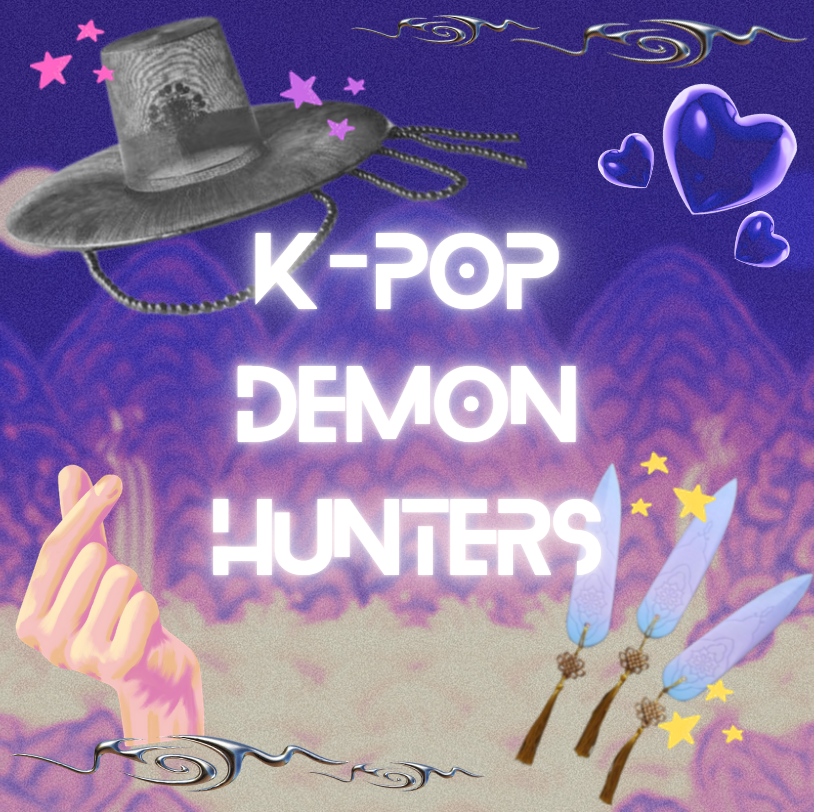
“K-pop Demon Hunters” is a Korean traditional culture-based fantasy animation in which the members of the global girl group Huntrix perform as idols during the day and fight evil spirits at night with the secret of exorcism.
While watching the movie, I could see the producers’ effort to keep it culturally authentic. The whole movie was a detailed showcase of Korean culture.
Huntrix had their own weapons to fight demons. Rumi’s sword “Sain-geom,” Mira’s sword “Gok-do” and Zoey’s sword “Shin-kal” are all ancient swords that were used during the Joseon period.
The Joseon period (1392-1910) was the last era of monarchy before modernization in Korea.
The stage that Huntrix performed on was also fascinating. I was able to notice that the members are performing the song “Golden” in front of the painting “Irworobongdo,” which means the painting of the sun, moon and five peaks. This painting used to be placed behind the throne of the kings of the Joseon dynasty.
There were also some small cultural details that only Koreans would recognize.
For example, the characters put their spoons and chopsticks on top of tissue paper when eating at a restaurant. Koreans often do that to keep the utensils clean.
Some cars were parked in areas marked “No Parking.”. Embarrassing as it may be, I couldn’t help but feel a sense of familiarity when I saw that.
Scenes such as characters sitting on the floor while leaning against a perfectly good sofa, or being overcharged at a Korean medicine clinic, were plenty enough that the movie left me, as a Korean viewer, in awe.
Familiar places such as Namsan Seoul Tower, the giant LED screen at the Convention and Exhibition Center, Naksan Park and the Olympic Stadium made me appreciate the movie even more.
The fact that actual Korean K-pop composers and Korean singers took part in creating the music also added to the movie’s appeal.
However, despite the participation of the Korean staff members, it didn’t feel like genuine K-pop due to the absence of Korean lyrics.
I wish all the lyrics were in Korean because the movie is about K-pop and Korean culture, but at the same time, I also think it’s amazing to capture fans all over the world with English lyrics.
Along with the musical staff, the voice cast also included familiar Korean actors.
It was a delight to hear the voices of well-known Korean actors Ahn Hyo-seop, who played Jinu, and Lee Byung-hun as Gwi-ma, who also appeared in “Squid Game.”
With the success of K-pop Demon Hunters, Korea is also experiencing a variety of events. From January to August this year, the National Museum of Korea recorded a total of 4,328,979 visitors, a 77.5% increase compared to 2,439,237 visitors during the same period last year.
Everland, the largest theme park in Korea, launched a collaboration with K-pop Demon Hunters by opening a theme zone on Sept. 26. Within five days of its opening, the zone attracted more than 10,000 visitors.
These interactive zones are continuously attracting not only Koreans but also visitors from all around the world.
The number of foreign visitors to Namsan Seoul Tower, one of the main places that appeared in the K-pop Demon Hunters, reached 79,200 as of last month; this is a 50.6% increase compared to 52,600 visitors during the same period last year.
K-pop Demon Hunters serves as a symbolic example of how Korean culture is interpreted and reimagined on the global stage.
As a Korean student living overseas, I feel proud that Korean culture is in the spotlight.
I hope Korean culture can maintain interest and love from people around the world through its unique charm.