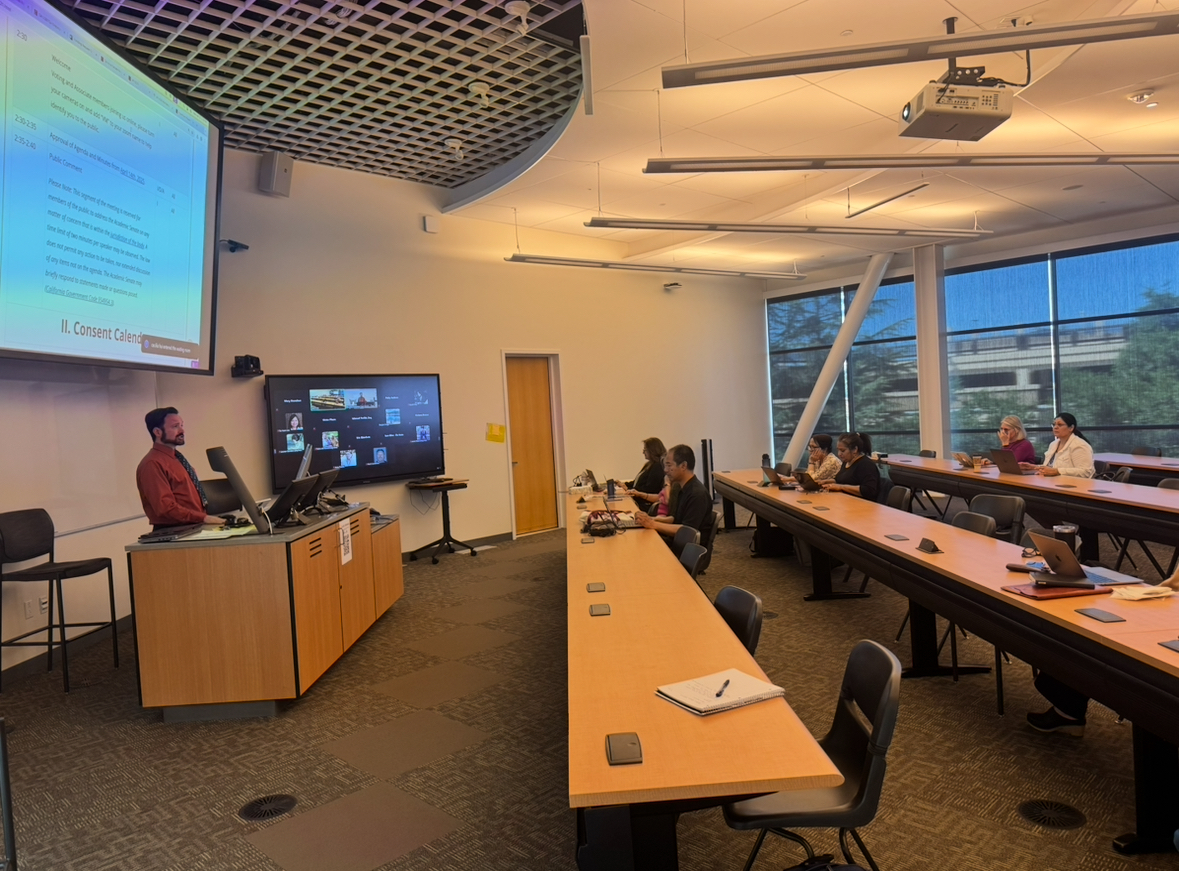

The De Anza College Academic Senate approved a motion to add quantitative reasoning to the list of Institutional Core Competencies on Monday, May 5 in the Media & Learning Center.
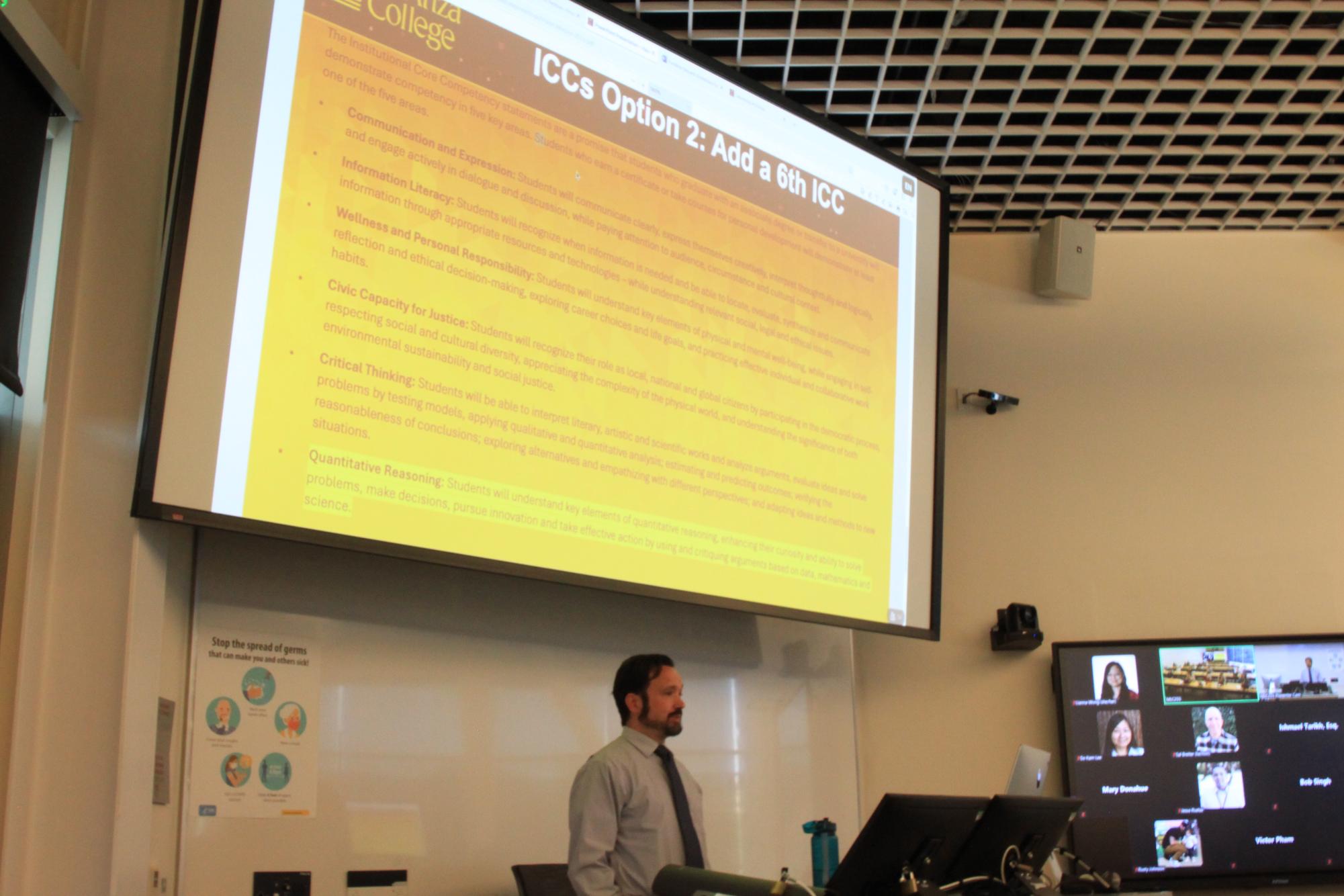
The Institutional Core Competencies are learning outcomes that students are expected to demonstrate while earning an associates degree or transfering to a four-year university. De Anza’s current ICC values are:
Communication and expression
Information literacy
Physical/mental wellness and personal responsibility
Civic capacity for global, cultural, social and environmental justice
Critical thinking
Quantitative reasoning is the ability to use and understand mathematical concepts to solve problems.
Mallory Newell, director of institutional planning research and accreditation, chair of the institutional wide college planning committee, proposed the addition of quantitative reasoning at a previous Senate meeting on Monday, April 21.
“We’ve left it open to two options because we wanted to take it to the Academic Senate, because these have to do with our ICCs,” Newell said. “First option: embed quantitative reasoning into our existing five ICCs, or adding a sixth ICC focused specifically on quantitative reasoning.”
Newell said the move to add quantitative reasoning stems from new accreditation standards.
Erik Woodbury, president of the Academic Senate, said during the meeting on April 21 that De Anza has already updated its general education plans to include quantitative reasoning as a new area.
Shagun Kaur, language arts representative, said during the April 21 meeting that she preferred adding quantitative reasoning as its own ICC, but felt the addition was jarring compared to the holistic approach of the other ICC’s.
“I would much rather add it in than butcher what is out there, because it’s so hard already with the current GEs to get a GE course to fit in those areas, and adding more words just creates more complexity,” Kaur said.
Mary Pape, computer information systems instructor, said that courses do not have to fulfill every ICC statement, so adding quantitative reasoning as a sixth ICC would not impact classes that do not fulfill it.
“Each course level outcome is mapped to a program level outcome, and each course level outcome is mapped to an ICC, or a part of an ICC,” Pape said.
“Remember the idea of a liberal arts education, you see a bunch of stuff, and we hit as many as possible,” Woodbury said. “If you look at the statement up here, ‘a student who earns a certificate or takes courses for personal development will demonstrate at least one of these.”
Veronica Acevedo Avila, English instructor, said she supports the idea of adding quantitative reasoning as a separate ICC statement during the April 21 meeting.
“I think it makes it more well rounded. I feel like that type of thinking has been, to some degree, dismissed, and I would love to see it there, actually,” Avila said.
Barbara Dahlke, transfer counselor, said she also supports adding quantitative reasoning as its own ICC statement.
“The UC’s and CSU’s have quantitative reasoning as something that’s a separate category under the Golden Four, and so it’s something that’s pointed out separately that’s important to them,” Dahlke said.
“We are trying to create people who are engaged citizens, and so in that sense itself, from a bigger perspective,” Kaur said during the May 5 meeting.