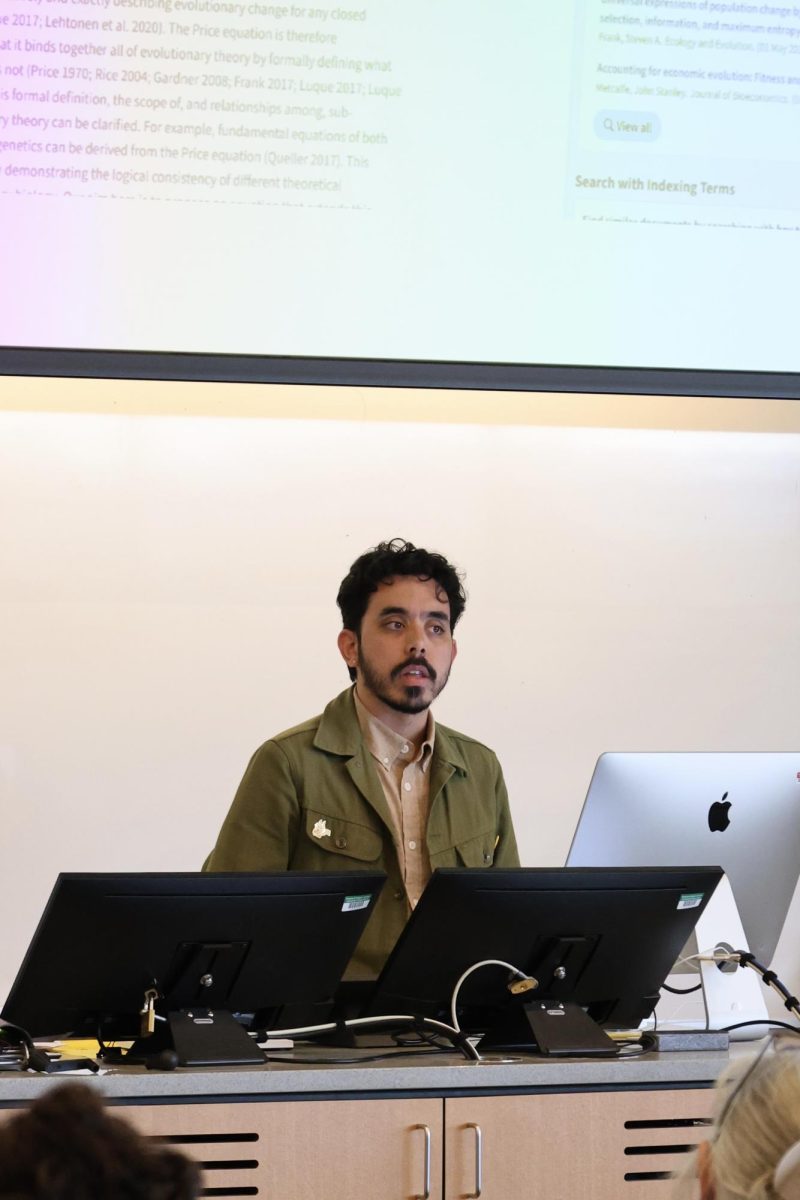

The De Anza College Academic Senate advanced a proposal supporting enterprise-level Google Gemini access for students during its meeting on May 18, concluding a weeklong debate over equity, privacy and academic integrity in the Media and Learning Center.
The proposal, passed 21-2 without abstentions, will advance to senior leadership. It could expand student access to Google Gemini and NotebookLM, aligning with Foothill College and many California public universities, partnered with tech giants, that already provide artificial intelligence resources.
Dean of Online Education and Learning Resources Gabriela Nocito said the proposal focused on the “equity gap” between students who can afford premium AI tools and those limited to free versions.
“It’s important to note that they’re using AI tools anyway,” Nocito said. “This is just the pro version and the more controlled and safer version that we can offer them.”
Nocito said that the proposal would not override instructors’ classroom policies regarding AI use.
Academic Senate President Shagun Kaur said district faculty groups are already developing AI literacy training and implementation frameworks for faculty and students.
However, some faculty members raised concerns about the technology because of how AI was discussed in the presentation slides.
“This isn’t just about AI literacy,” Part-time English and Asian American Studies instructor Sherwin Mendoza said. “We’re endorsing the use of AI for weapons; we’re endorsing the use of AI for surveillance.”
He shared concern that schools and students are under pressure to adopt technologies controlled by powerful corporations, such as Google.
The enterprise version of Gemini and NotebookLM offer higher usage limits, advanced reasoning capabilities, multimodal functions for text, audio and video, and institutional data controls according to the presentation. The proposal said these differences impact students’ research, writing and study workflows.
Visual Arts and Design instructor Yuri Chang, who voted against the proposal, said that many faculty members are concerned about its negative impacts on ethics and teaching, such as creating assignments.
AI can use human generated prompts and data from the web to train its model, which Chang described as “unpaid labor.”
Supporters of the proposal said faculty are now responsible for teaching ethical AI use rather than trying to ban it.
Full-time faculty of Child Development and Education and Sociology departments and Academic Senate Acting Vice President Jayanti Roy said AI is already part of students’ lives and classrooms.
“We have to level the playing field for students,” Roy said. “We have to teach them how to use it ethically.”
Roy said instructors should redesign assignments to require personal reflection, classroom engagement and critical thinking that cannot easily be replicated through AI-generated responses.
“It’s not that everybody is bad,” Roy said. “I would much rather, in my life, believe there is goodness, … there are ethics, and we work in a partnership with our students to show them the need for ethical use of such technologies.”
Students expressed mixed reactions regarding the senate’s action.
“AI takes away students’ ability to conduct their own research,” Ariel Orozco, 18, psychology major said. “I agree that AI is useful in the medical field, but at the end of the day I don’t think the school’s decision is necessary.”