



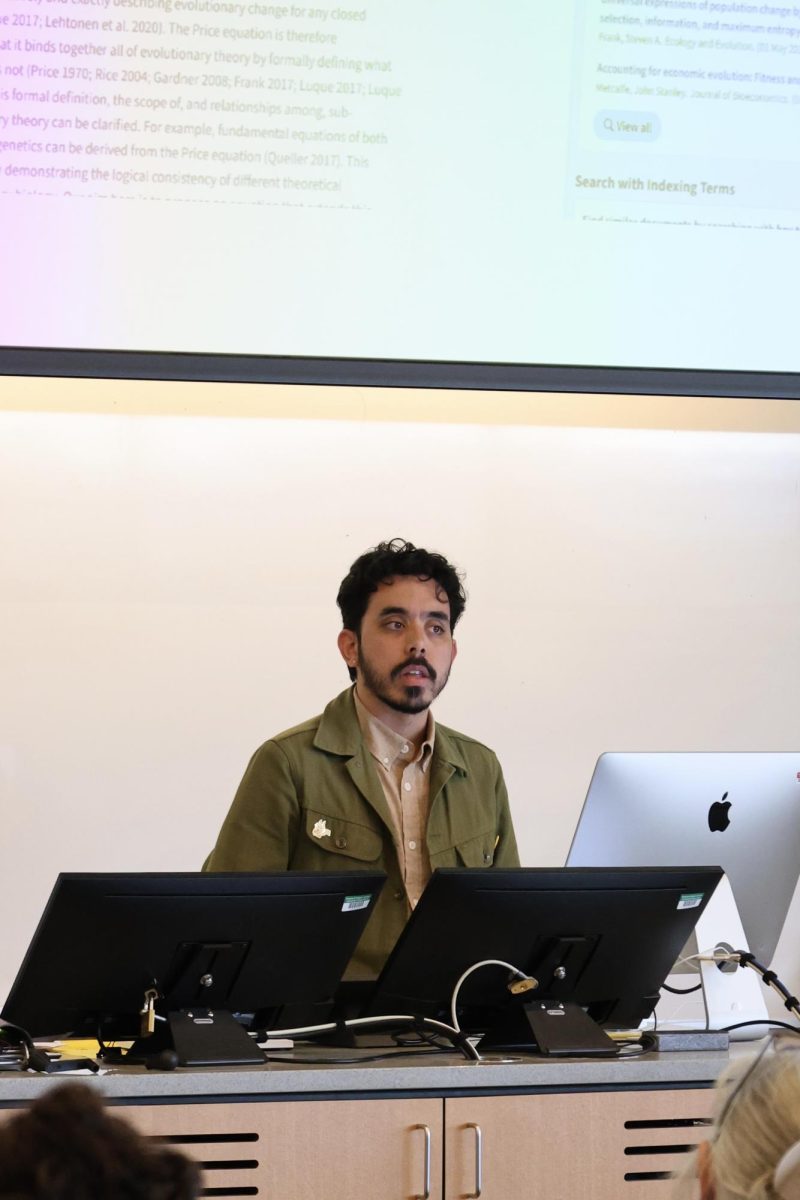
The Robert DeHart Library introduced a redesigned database webpage with four free AI-powered research tools at the De Anza College Academic Senate meeting on May 4 in the Media and Learning Center.
Equity and Instructional Librarian and Open Educational Resources Coordinator James Perla-Adams restructured the library’s database page to sort all databases by De Anza’s Guided Pathways Villages.
The new AI tools are JSTOR Research Assistant, ProQuest Research Assistant, EBSCOhost Natural Language Search and AI Insights and OneSearch Research Assistant.
Perla-Adams said that all new AI research tools are free to students, come from database vendors and are included in the college’s existing library contracts. Vendors activated the tools automatically, and the library cannot disable them.
“The database page is a structural change to make it more friendly for students,” Perla-Adams said. “The AI tools are built into databases students already access.”
The four AI tools carry distinct functions and access rules:
JSTOR Research Assistant: Requires a free JSTOR account and offers AI-powered text-focused search iteration and source summaries.
ProQuest Research Assistant: Needs no account, activates automatically. It provides source summaries and data visualization with a more visual interface.
EBSCOhost Natural Language Search & AI Insights: Needs no account. Lets users type plain-language questions instead of structured keywords. It converts questions to keyword searches and generates broad bullet-point summaries of sources.
OneSearch Research Assistant: Requires MyPortal login and specific terminology input to deliver targeted academic results.
Perla-Adams said that JSTOR and ProQuest are unable to search materials where its publishers control content licensing for AI tools.
Excluded materials are not listed publicly, and users only learn of restrictions when the AI tool marks a source as unavailable.
Perla-Adams said the library is always looking to increase and update its services and resources.
“It is nice that we now have the expert (Perla-Adams) on information literacy, guiding how AI tools are integrated into something as important as research and critical thinking,” Academic Senate acting president Shagun Kaur said. “Having that option is necessary as the educational landscape changes.”
Academic Senate acting president Shagun Kaur said that the new library AI features are important but its necessity varies by academic discipline, instructor pedagogy and course learning outcomes.
Academic Senate executive secretary So Kam Lee said the updates help students overcome the longstanding difficulty of researching and identifying credible sources.
“Students don’t know where to go and don’t know what’s accurate, so these tools really help,” Lee said.
The library updated its database research orientations and Perla-Adams said it now provides AI literacy content students and faculty can request in-person, Zoom or recorded presentations via a form on the library’s webpage.

