
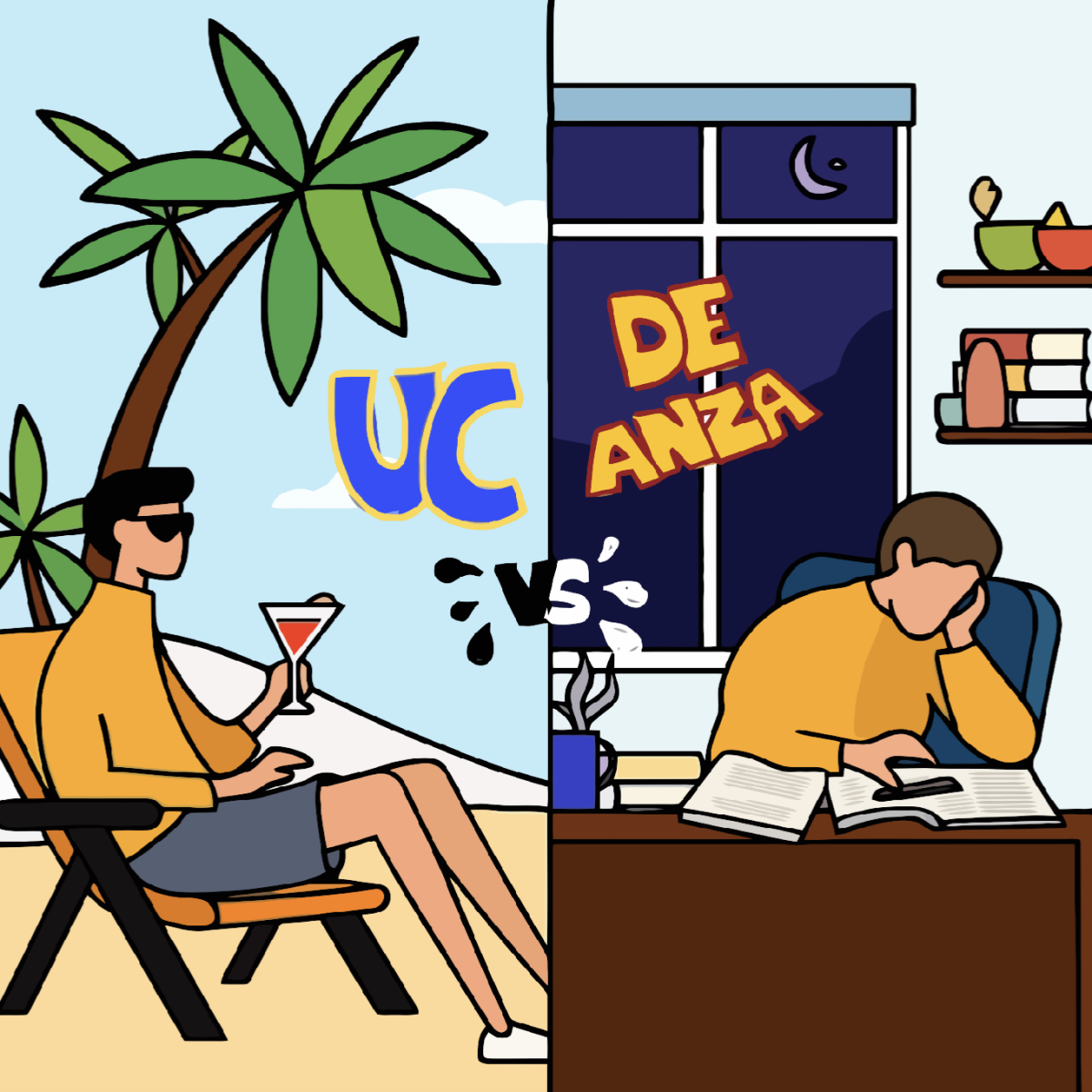
A warm summer breeze sweeps through the empty De Anza quad the last week of June.
Typically, an empty campus at this time of year means students are enjoying their summer break. However, at De Anza they’re busy studying for finals, yearning for their eventual freedom.
It’s not unusual for a quarter system school to start and end the academic year later than a semester school, such as UC Berkeley and UC Merced which ended May 16 and begin fall semesters on Aug. 20.
This gives a transferring De Anza student less than a 60-day summer compared to the almost 100 days of vacation for those already at one of the semester UCs.
Even other quarter system-schools have longer summers. The rest of the UCs, on the quarter system, had finals the week of June 9 while De Anza’s didn’t begin until June 23.
The UCs and many other U.S. quarter schools successfully operate with 10 weeks of instruction plus one week for finals compared to De Anza’s 12-week total. This contributes to the two-week discrepancy.
More closely aligning De Anza’s quarter system with many four-year institutions would better prepare students who plan on transferring.
The summer isn’t just for relaxing; it can be a crucial transitional period, especially for transfer students who have to worry about moving to entirely new schools in unfamiliar areas and meeting critical deadlines while their transfer decision is still provisional.
The UCs require final transcripts to be sent in by July 1, but De Anza’s quarter officially ends only a few days before the deadline.
De Anza counselor Umar Douglas said the current system operates with the UCs’ understanding that De Anza students “can’t meet the deadline.” In fact, despite the written deadline, UCs expect Foothill College and De Anza transcripts to be submitted late.
“I do empathize with how it is awkward for students,” Douglas said. “It’s just kind of the nature of the beast, so to speak.”
De Anza should change the length of its quarters. It wouldn’t be easy, but the benefits of adopting the same 11-week UC quarter system could be worth it.
In 2001, panel participants of the Academic Senate for California Community Colleges named four groups of concerns when altering academic calendars: “integrity of the academic program, contractual issues, institutional support and infrastructure, and most importantly, student needs.”
The process of changing the calendar is complex, but the concerns raised by the panel can be mitigated with careful planning. The panel participants suggested changes should have “a time frame of about two years” to plan and implement.
Their last concern, that students will struggle with the more compressed format, should be at the forefront of any decision.
It’s hard to ignore the advantage of an additional week of instruction. But do we need more time to teach the same or more basic material?
The UCs and other notable quarter schools such as Stanford, Caltech and Northwestern, complete upper division courses — which are more in-depth and rigorous compared to the general education and lower division courses De Anza offers — in a shorter time period.
The end of the academic year and the summer before transferring are already stressful. Students are expected to say goodbyes, relocate and jump through hoops to meet transfer requirements. Here at De Anza, we have less time to do it.
Thankfully, the isolation and added pressure of the quarter bleeding late into the summer is preventable.
While 14 days may seem trivial, the extra time can make or break a student’s experience.