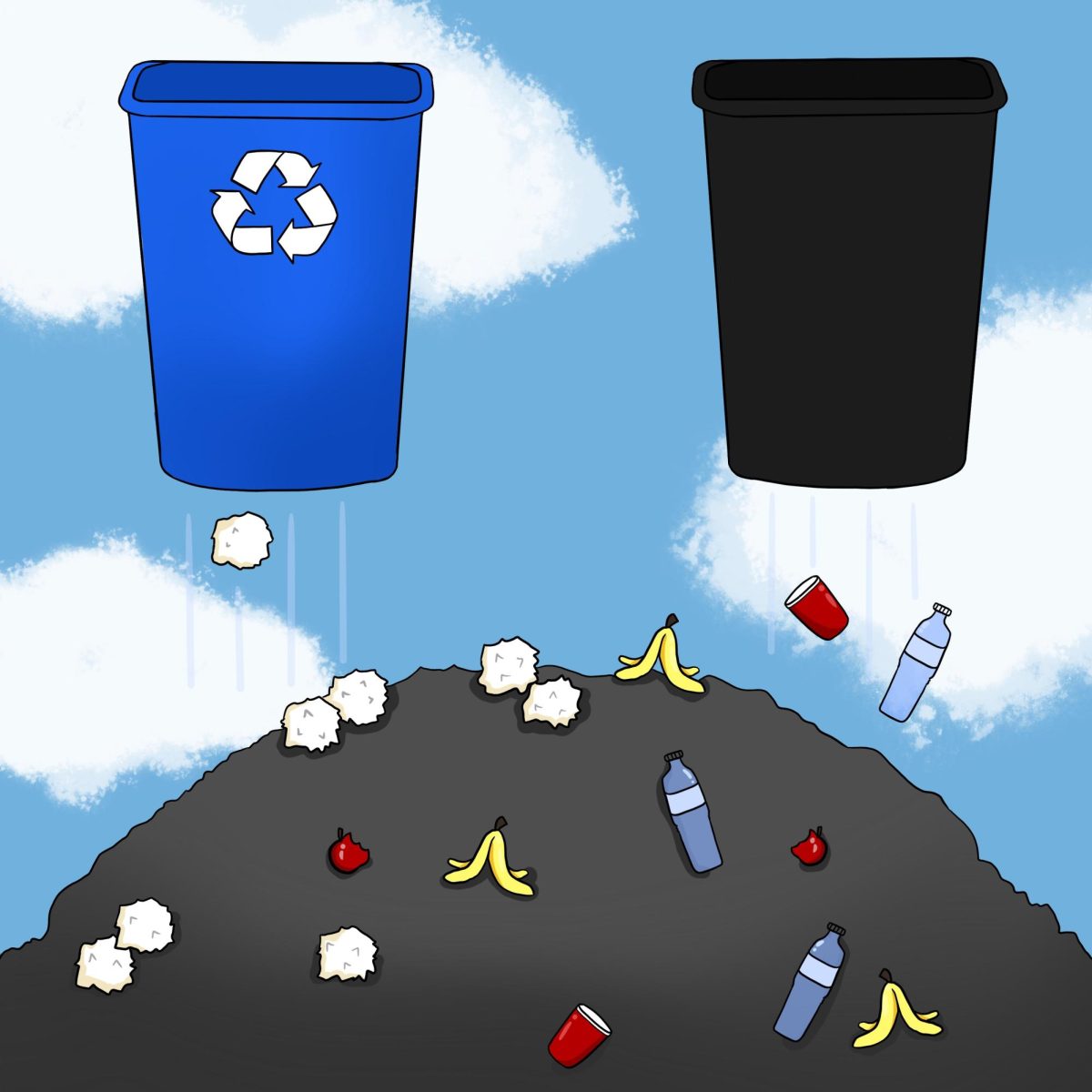
De Anza College has made many poor decisions in order to save money. Choosing Recology’s “single stream recycling” program is one of them.
De Anza’s campus has what’s called a “single stream recycling” system.
According to the Container Recycling Institute, single-stream recycling is a system in which all recyclables are placed in a single bin for recycling.
Across campus, De Anza does have blue recycling bins. One would think that because it has already been sorted, Recology wouldn’t have to mix and sort through it again.
Except according to De Anza’s recycling webpage, “Any trash you put into a recycling or waste bin at De Anza will be transferred to a large compactor container.”
So the blue recycling bins across campus serve no purpose except to pose as a sort of greenwashing to make De Anza appear more sustainable than it is.
The large compactor container of trash and recycling is picked up by Recology South Bay. Then they take all waste and sort it for recycling, composting or delivery to a landfill location.
This is a program offered by Recology to its commercial garbage collection customers, at no extra charge.
What this means is that the school doesn’t have to worry about paying staff to sort trash and recycling.
According to CalRecycle, back in 2018, California dumped more than 12,000 tons of plastic into landfills every day — enough to fill 219 Olympic-size swimming pools.
One of the biggest issues with single stream recycling is that a lot of recyclable material is contaminated and therefore becomes landfill.
According to the Container Recycling Institute, “There is significant evidence that the resulting scrap material quality is lower under single-stream collection than it is under a dual stream system.”
Even just adopting a “dual stream system,” where students can combine all their food and beverage containers in one bin, and put newspapers and/or mixed paper in another bin, would solve the issue of recyclable material becoming contaminated.
Although the college was able to reduce the number of pickups by switching to a single stream recycling program, sorting through our own recycling will reduce our carbon footprint times 10.
According to the Institute For Local Self-Reliance, “Single stream recycling may reduce the costs of collection, but if the materials are contaminated the cost and quality of processing is poor, then materials cannot be sold.”
De Anza should switch over to a dual stream system where students can sort their own trash into recyclables and trash where recyclable materials won’t be contaminated.